
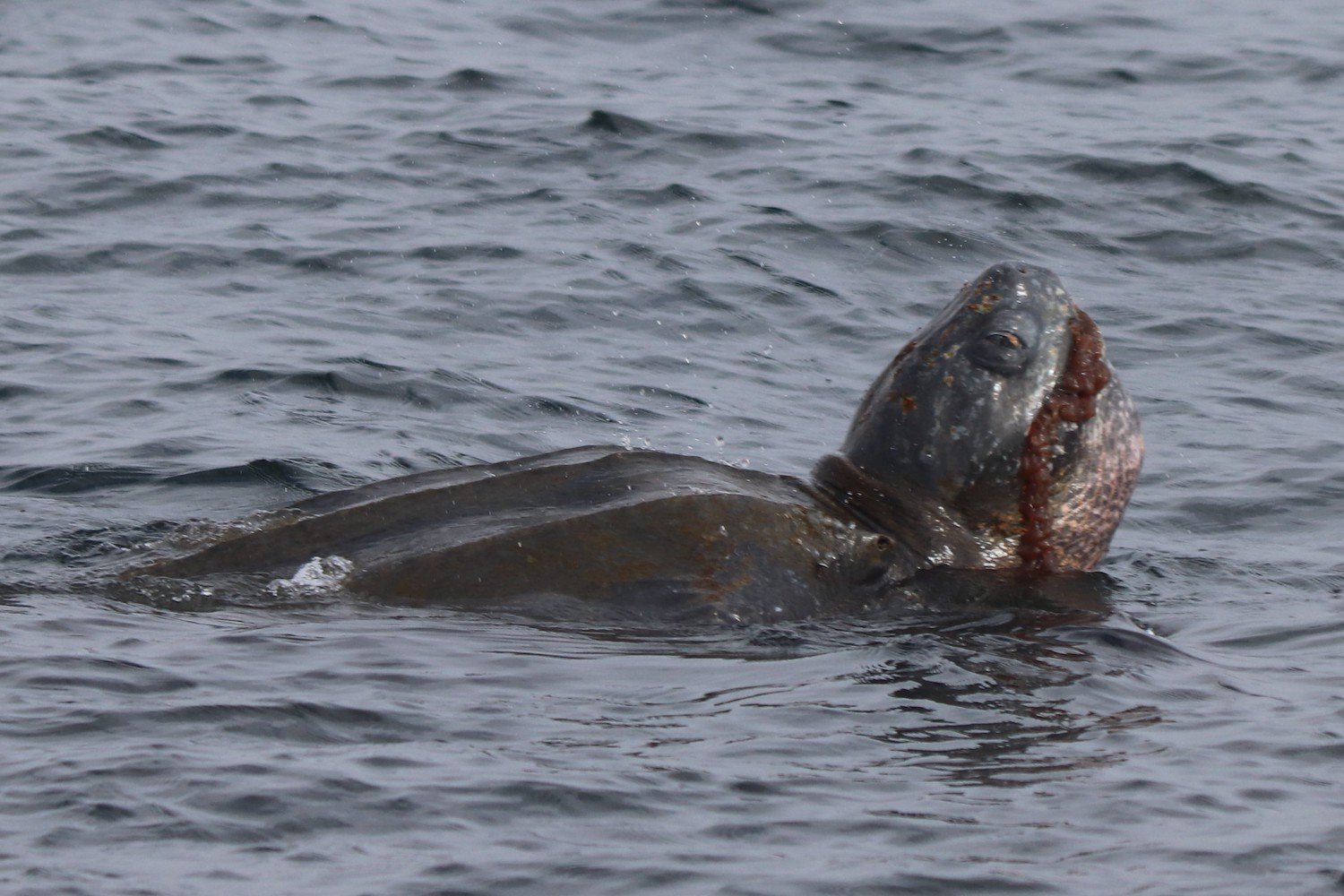
At Upwell, we’re always seeking new ways to mobilize data to power sea turtle conservation—but sometimes data are scarce or don’t exist. Sea turtles spend their lives circling the oceans, so we can only collect data on nesting beaches or through in-water monitoring and remote sensing like satellite tagging. Even though we are working to improve technology to allow for further data collection, there are still many gaps in our understanding. Predictive models can help us fill in these gaps by using algorithms to explore what we can’t observe directly in the wild.

Photo by Max Gotts
One example is the Sea Turtle Active Movement Model (STAMM), which simulates where sea turtle hatchlings travel after they disappear into the open ocean. To do this, STAMM has to make estimates about certain aspects of leatherback physiology, like their growth rates under various environmental conditions.If we want to be more precise, there is another model that we can use to help improve the physiology-related estimates: a Dynamic Energy Budget (DEB) model.
DEB models use fundamental laws of energy and mass conservation (like the first law of thermodynamics) to describe how animals acquire and allocate energy to maintenance, growth, development, and reproduction over their lifetime. For a leatherback turtle, this means accounting for how the energy gained from eating jellyfish is stored in fat reserves and then used to fuel growth, and eventually contribute to reproduction. A DEB model turns these processes into a set of equations, plugging in known amounts, like the energy provided by consuming jellyfish, to predict unknown amounts, like when a leatherback could reach maturity, or how many eggs it might be able to produce in its lifetime.
Upwell Researcher Anna Ortega embarked on the modeling journey for leatherbacks in the Northwest Atlantic Ocean. “I’m a big proponent of using modelling to answer questions that are hard to tackle in the field. When we’re working with endangered populations—especially species that spend much of their lives in places we can’t easily study—we need tools that help us fill these critical knowledge gaps to move conservation one step forward.”
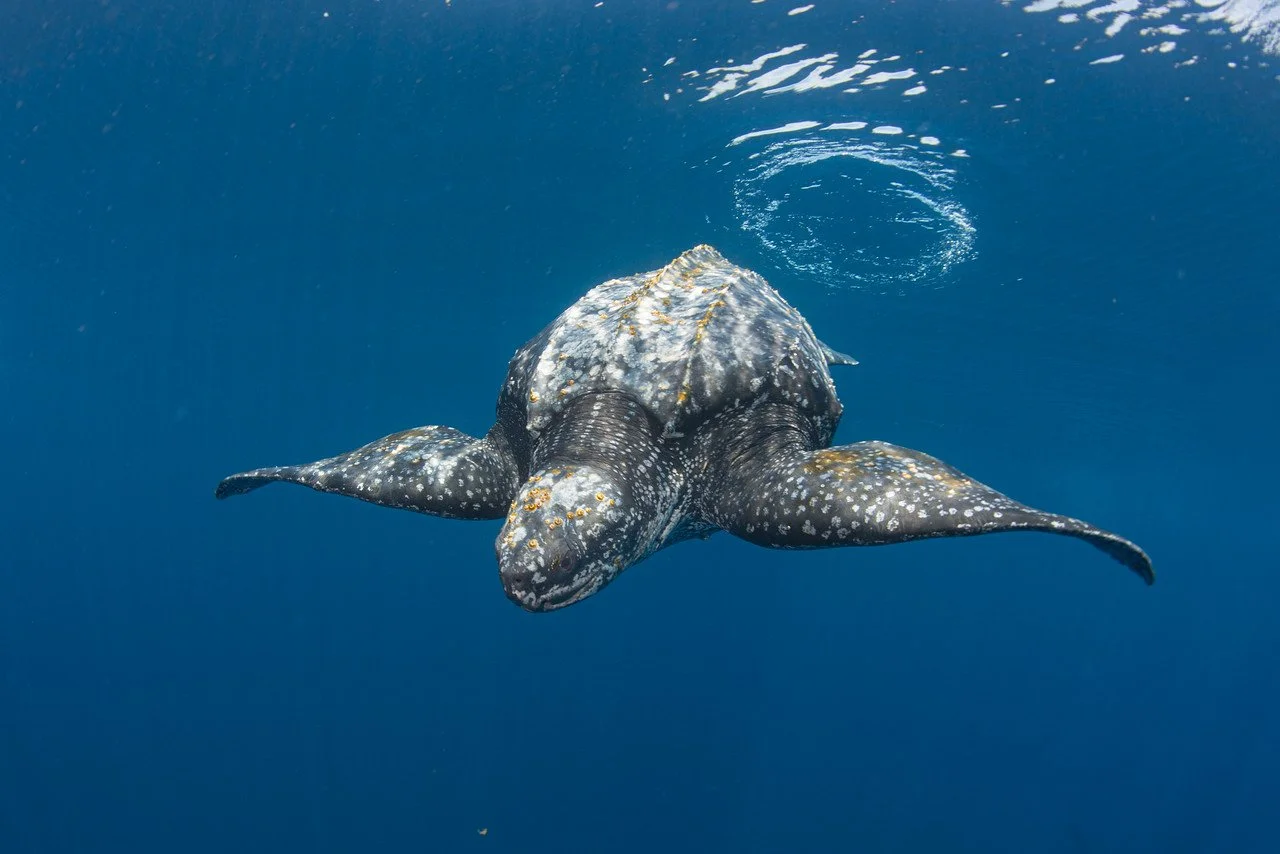
Photo by Jason Isley / Scubazoo
After first hearing the term “DEB theory” in 2022 when she started her PhD at the University of Western Australia, Anna took a deeper dive with a course on it in 2023. For further guidance, she collaborated with Dr. Nina Marn, a biologist and DEB specialist at the Ruđer Bošković Institute in Croatia, whose work includes modeling effects of plastic ingestion (including on sea turtles) using DEB models. Dr. Marn says that, “Once you embrace the equations and a potentially steep climb up the learning curve, a world of exploration opens up, where you can use a well designed model to simulate a range of conditions and scenarios. This helps us understand the species, and helps identify critical threats. Some threats we might potentially miss when focusing on data only, either because data is scarce, or because effects could take years to develop. This is especially true for slow growing, slow maturing animals such as sea turtles.”
Building a DEB model requires baseline data to train the model, for example how much a leatherback ate and then how much it grew under known conditions. As we mentioned, these kind of data on leatherbacks are incredibly difficult to obtain when leatherbacks' life history involves disappearing into the surf shortly after hatching. Upwell has an ongoing partnership and provides support for the captive-rearing of leatherbacks at the Florida Atlantic University Marine Lab—one of the few labs in the world that captive-rears juvenile leatherbacks up to three months old under the direction of Dr. Jeanette Wyneken.
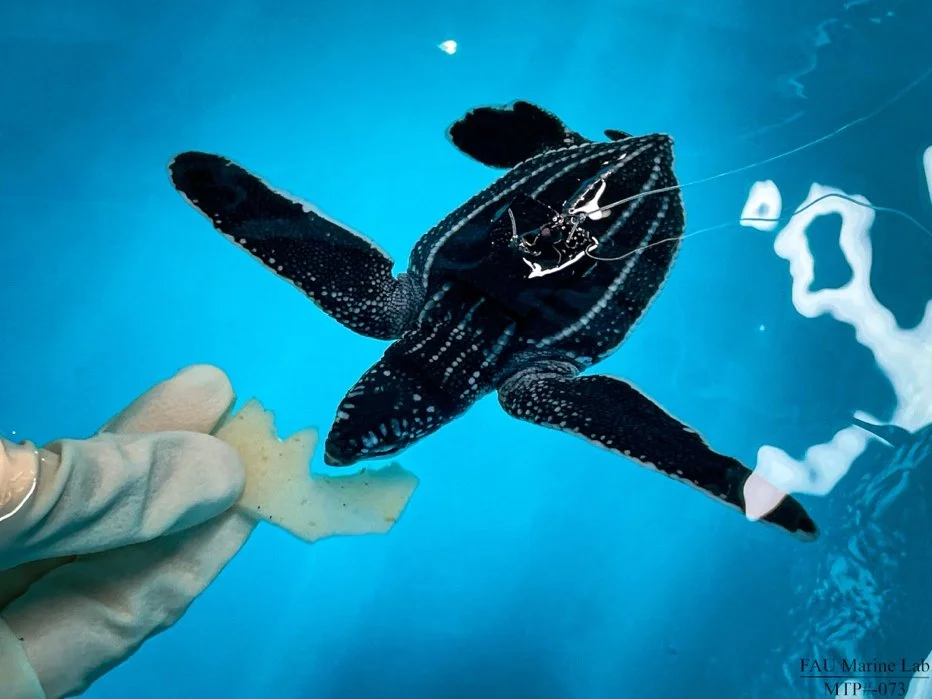
Photo courtesy FAU Marinelab MTP# 073
While hatchlings are in the lab, they are fed a carefully designed diet and regularly weighed and measured, providing rare, high-quality data on early growth and energy use—exactly the kind of data needed for a DEB model. Dr. Wyneken expressed that she was excited to contribute data to the effort, saying, “Throughout my career I have heard or read that we don’t have the data to answer some of the most fundamental questions about the youngest life stages. While many questions remain about leatherbacks at sea, the DEB gives the first answers about how these turtles live, grow, and survive far from direct observations. It’s a game changer!”
Anna was also able to find further data points on the presumed leatherback age at maturity, size at maturity, size at hatching, weight at hatching, and weight of eggs in other sea turtle research studies. With these critical data in hand, Anna and Dr. Marn began the difficult task of crunching the numbers. Using a program called MATLAB, they spent countless hours fitting parameters, running simulations, and evaluating how well the model was able to reproduce the growth trends from The Marine Lab data.
Anna reflects on the process, saying, “The hardest part was getting the model to behave like a real turtle. Combining data collected under different conditions required a lot of testing and checking whether the results made biological sense. But once the model fit the data, it became incredibly satisfying—almost like a new toy you can use to ask all sorts of questions.”
Now that the model is completed, it can be used to simulate how changes in ocean temperature and food availability affect a leatherback’s ability to grow and reach reproductive size. These simulations showed that turtles in warmer waters with abundant food grow faster, mature earlier and have greater reproductive potential. This pattern is expected because, although leatherbacks can retain some body heat and tolerate the cold better than other sea turtles, their growth and energy use are still strongly influenced by environmental temperature—especially when they are smaller.

Photo by Heather Harris
As leatherback turtles grow larger, they become less sensitive to temperature, but access to food remains critical. The model shows that even small reductions in food availability can prevent leatherbacks from gaining enough energy to reach sexual maturity and reproduce, regardless of the water temperature. If environmental conditions prevent turtles from growing large enough to reproduce it could put population recovery at risk. Estimating this relationship between environment and reproductive potential can help to guide conservation efforts - especially as climate change alters ocean ecosystems.
Upwell’s Executive Director George Shillinger hopes that the model can play a role in informing conservation efforts, saying, "As the ocean environment changes rapidly, tools like DEB models offer a way to anticipate how those changes may affect leatherbacks, and we hope to put them into action to develop more targeted, strategic conservation strategies to support leatherback survival.”
You can read the complete manuscript, “Food, Glorious Food! Energy budget and reproductive potential of critically endangered leatherback turtles explored with mechanistic modeling“. This work was funded by The University of Western Australia and Upwell Turtles, and was supported by the Croatian Science Foundation grant IP-2022-10-5901 QPlast. This work was made possible by the Florida Atlantic University Marine lab staff and student teams, especially E. Turla, for collecting and providing data on leatherback growth and diets in captivity.